If you've been brewing pour over coffee with water heated on the stove and poured from a regular kettle, I have news: you're making your life significantly harder than it needs to be. An electric gooseneck kettle is, without exaggeration, the single most impactful upgrade you can make to your pour over setup — more important than your dripper, arguably more important than your grinder (though don't tell the grinder people I said that).
The reason is flow control. Pour over coffee extraction is fundamentally about how water contacts the coffee bed. A standard kettle dumps water in an uncontrollable gush that creates channels, over-extracts some grounds while under-extracting others, and makes it nearly impossible to execute a consistent, even pour. A gooseneck spout transforms that gush into a precise, controllable stream — thin enough to target specific areas of the coffee bed, slow enough to maintain an even flow rate, and predictable enough to replicate your technique brew after brew.
Add electric heating with variable temperature control, and you eliminate the other major source of pour over inconsistency: water temperature. Different coffees extract optimally at different temperatures — light roasts generally want hotter water (200–205°F), dark roasts prefer cooler water (195–200°F), and dialing in that 5-degree window makes a genuinely noticeable difference in cup quality. The best electric gooseneck kettles let you set temperature to the degree, hold it there indefinitely, and start pouring within 3–5 minutes of flipping the switch.
I've spent months testing these kettles side by side, cross-referencing with thousands of verified owner reviews on Amazon, Reddit's r/coffee community, and specialty coffee forums like Home-Barista and CoffeeGeek. The market ranges from $30 no-name imports to $200+ premium options — and the price difference isn't always justified. Here are the seven that actually earn their place on your counter.
Quick Comparison Table
| Kettle | Capacity | Temp Control | Wattage | Best For | Price Range |
|---|---|---|---|---|---|
| COSORI Original Top Pick | 0.8L | 5 presets (140–212°F) | 1200W | Best all-around | ~$63 |
| Fellow Stagg EKG Pro | 0.9L | 1°F precision (104–212°F) | 1200W | Serious enthusiasts | ~$200 |
| Bodum Bistro | 0.8L (27 oz) | None (boil only) | 1000W | Budget buyers | ~$40 |
| Mecity Barista Edition | 0.8L | ±1°F precision | 1200W | Precision on a budget | ~$56 |
| INTASTING | 0.9L | ±1°F precision | 1000W | Mid-range value | ~$59 |
| Bodum Melior | 0.8L (27 oz) | None (boil only) | 1000W | Minimalist design | ~$36 |
| COSORI Smart | 0.8L | ±1°F via app | 1200W | Smart home users | ~$63 |
1. COSORI Electric Gooseneck Kettle — Best Overall

The COSORI Electric Gooseneck Kettle has earned Amazon's Choice status for good reason — it's the kettle that nails the balance between functionality, build quality, and price better than anything else on the market. With 19,100+ reviews and a 4.6-star average, it's not just popular; it's statistically one of the highest-rated kettles in its category, with 3,000+ units sold per month.
The five temperature presets (140°F, 160°F, 175°F, 185°F, and 212°F) cover every brewing scenario you're likely to encounter. For pour over, the 175°F and 185°F presets bracket the sweet spot for most medium-roast coffees. For lighter roasts that benefit from hotter water, you'll use 212°F and let it cool for 30 seconds. For green tea, the 175°F preset is precisely where you want to be. The hold function maintains your target temperature for up to 60 minutes — which means you can set it, grind your coffee, prepare your dripper, and the water is still exactly where you need it when you're ready to pour.
Build quality is genuinely impressive for the price point. The interior is 100% stainless steel — no plastic touching the water at any point, which matters both for taste and for longevity. The exterior has a matte black finish that resists fingerprints and looks sharp on a kitchen counter. The gooseneck spout produces a thin, controllable stream that's well-suited for Hario V60, Kalita Wave, and Chemex brewing. The flow rate sits in that ideal middle ground — slow enough for precise pours, fast enough that you're not standing there for five minutes during a single brew.
The 1200W heating element brings water to a boil in approximately 3–5 minutes, which is meaningfully faster than the 1000W competitors. The auto-shutoff and boil-dry protection are standard safety features, but COSORI's implementation is reliable — I've never had a false trigger or a failure to shut off during months of daily use.
Where the COSORI falls slightly short of premium options is in temperature granularity. The five presets are well-chosen, but you can't dial in a specific temperature like 198°F or 203°F the way you can with a Fellow Stagg or Mecity. For most home brewers, the presets are more than sufficient. For competition-level precision, you'll want to step up.
Pros
- Amazon's Choice — 19,100+ reviews at 4.6 stars
- Five well-chosen temperature presets with 60-min hold
- 100% stainless steel interior — no plastic contact
- 1200W fast heating (3–5 min to boil)
- Excellent gooseneck flow control for pour over
- Attractive matte black design
Cons
- Preset temperatures only — no degree-by-degree control
- 0.8L capacity may require refills for larger Chemex brews
- Base has a small footprint — can feel tippy when empty
Best for: The overwhelming majority of home pour over brewers. If you want an excellent gooseneck kettle without overthinking it, this is the one to buy. The price-to-performance ratio is unmatched.
Check Price on Amazon2. Fellow Stagg EKG Pro — Best Premium Pick

The Fellow Stagg EKG is the kettle you'll find on the counter of virtually every specialty coffee shop, every barista competition stage, and every serious home brewer's setup. The Pro version builds on that legendary reputation with Bluetooth connectivity, a built-in brew timer, scheduling capabilities, and the same precision temperature control that made the original a category-defining product.
Let's talk about what you're actually paying $200 for. The temperature control is degree-by-degree from 104°F to 212°F — meaning you can dial in precisely to 201°F, 203°F, or any specific temperature your coffee demands. The LCD display shows both the target and current temperature in real time, and the built-in stopwatch lets you time your bloom and pour phases without needing a separate timer or phone app. For pour over methodology, where the difference between a 30-second bloom and a 45-second bloom is genuinely tasteable, this integration is more valuable than it might sound on paper.
The gooseneck spout on the Stagg EKG is widely considered the best in the industry. The precision of the pour is remarkable — you can produce a stream as thin as a pencil or open it up to a moderate flow, with smooth transitions between the two. The counterbalanced handle gives you intuitive control over the pour angle, and the weighted feel of the kettle makes slow, circular pours almost effortless. This is what baristas mean when they talk about a kettle that "disappears in your hand."
The Pro's Bluetooth features include app-based temperature scheduling (set your kettle to reach 205°F at 6:45 AM so it's ready when you walk into the kitchen), variable hold times, and brew tracking. Whether these features justify the premium over the standard EKG depends entirely on how deep you are into the pour over rabbit hole — but for the people who want them, no other kettle offers them.
The 0.9L capacity is slightly larger than the COSORI (0.8L), which matters for Chemex brewers who need 600–700ml of water per brew. Build quality is exceptional — the Stagg EKG feels like a $200 product in a market full of products that don't. It's also available in multiple finishes (Matte Black, Polished Steel, Copper, and limited editions), making it one of the few kitchen appliances that genuinely functions as a design object.
Pros
- Industry-standard gooseneck — best-in-class pour control
- Degree-by-degree temperature precision (104–212°F)
- Built-in brew timer and LCD display
- Bluetooth app with scheduling and brew tracking
- Counterbalanced handle for ergonomic pouring
- Stunning design — available in multiple finishes
Cons
- $200 is three times the price of equally functional alternatives
- Bluetooth features are niche — most people won't use scheduling
- 4.1-star average suggests some quality-control inconsistency
- Lid doesn't lock — can slide off during aggressive pours
Best for: Dedicated pour over enthusiasts who want the absolute best pouring experience, degree-level temperature precision, and a kettle that looks as good as it performs. If coffee is your hobby — not just your morning caffeine — this is the kettle to own.
Check Price on Amazon3. Bodum Bistro Gooseneck Kettle — Best Budget Pick

Bodum has been making coffee equipment since 1944, and that heritage shows in the Bistro — it's a clean, well-built gooseneck kettle from a brand that genuinely understands what coffee brewers need. At $40, it's the most affordable name-brand electric gooseneck on this list, and with 13,000+ reviews at a 4.4-star average and 2,000+ units sold monthly, the market has clearly validated its value proposition.
The immediate trade-off at this price point is the absence of variable temperature control — the Bistro is a boil-only kettle. You turn it on, it heats to boiling, and it shuts off. For pour over, this means you'll need to boil the water and then let it sit for 30–60 seconds to reach your target brewing temperature (approximately 200–205°F for most medium-roast coffees). This is the technique that professional baristas used for decades before variable-temperature kettles existed, and it works perfectly well — it's just less convenient than pressing a button and walking away.
What the Bistro does well, it does very well. The gooseneck spout produces a controlled, even stream that's absolutely suitable for V60, Kalita Wave, and Chemex brewing. The stainless steel construction is sturdy and attractive in the matte black finish. The 27-ounce (0.8L) capacity is standard for the category. And the Bodum name carries genuine warranty and customer service backing that you won't get from Amazon marketplace brands.
The 1000W heating element is slower than the 1200W competition — expect approximately 4–6 minutes to reach a full boil versus 3–5 minutes. In practice, this difference is rarely noticeable in a morning routine. The base is corded, meaning you can't rotate the kettle 360° on the base like most modern designs; the cord exits from a fixed point. This is a minor inconvenience for left-handed users but isn't a dealbreaker.
For someone entering the pour over world and wanting a proper gooseneck without spending $60+, the Bodum Bistro is the clear recommendation. It proves you don't need temperature presets or Bluetooth to brew excellent coffee — you just need a good spout, good build quality, and a thermometer (or the patience to wait 45 seconds after boiling).
Pros
- Trusted Bodum brand — 80+ years in coffee equipment
- 13,000+ reviews at 4.4 stars with strong sales
- Excellent gooseneck flow control at the lowest price
- Stainless steel build with attractive matte finish
- Simple operation — no buttons to figure out
Cons
- No temperature control — boil-only operation
- 1000W heating is slower than 1200W competitors
- Fixed cord position limits base rotation
- No hold/keep-warm function
Best for: Pour over beginners on a budget, anyone who already owns a thermometer, and brewers who value simplicity and brand reliability over features. This kettle proves the gooseneck shape matters more than the tech built around it.
Check Price on Amazon4. Mecity Electric Gooseneck Kettle (Barista Edition) — Best Temperature Precision
The Mecity Barista Edition is the kettle that makes the Fellow Stagg EKG nervous — because it offers ±1°F temperature precision, a sleek design, and a 1200W quick-heating element at less than a third of the Stagg's price. With 2,400+ reviews and a 4.4-star average, it's built a loyal following among cost-conscious pour over enthusiasts who refuse to compromise on temperature accuracy.
The degree-by-degree temperature control is the headline feature, and it works exactly as advertised. You can set any target temperature between 104°F and 212°F using the intuitive dial on the base, and the kettle reaches your target with ±1°F accuracy. The real-time temperature display shows both the current and target temperatures, so you can watch the heating progress. The hold function maintains your target temperature for up to 60 minutes — matching the COSORI and Fellow offerings at a fraction of the cost.
The 0.8L capacity and 1200W heating element are identical specs to the COSORI, and in practice, the heating performance is comparable: roughly 3–5 minutes to reach a full boil. The matte black finish is clean and fingerprint-resistant, and the build quality feels solid — not quite Fellow-level premium, but meaningfully better than generic Amazon marketplace kettles.
The gooseneck spout produces a good pour — controllable and precise enough for V60 and Kalita brewing. It's not quite as refined as the Fellow Stagg's legendary spout design, but the difference is marginal and wouldn't be noticeable to anyone who isn't doing direct side-by-side comparisons. For the vast majority of home brewers, the Mecity's pour control is more than sufficient.
The main knock against the Mecity is brand longevity — it's a newer brand without the decades-long track record of Bodum or the specialty-coffee credibility of Fellow. That said, the warranty coverage is reasonable, and the reviewer consensus suggests reliable long-term performance. Several Reddit r/coffee users have reported daily use for 12+ months without issues.
Pros
- ±1°F temperature precision — degree-by-degree control
- 1200W quick heating matches premium competitors
- 60-minute temperature hold function
- Real-time temperature display (current and target)
- Under $60 — fraction of Fellow Stagg's price
- 2,400+ reviews with strong reliability reports
Cons
- Newer brand — less proven long-term track record
- Gooseneck spout not as refined as Fellow Stagg
- 0.8L capacity may limit larger brew sessions
- Dial interface can feel slightly imprecise vs button controls
Best for: Pour over enthusiasts who want degree-level temperature control without the $200 premium. If you care about precise extraction but your budget says "not Fellow," the Mecity Barista Edition is the smartest buy in this category.
Check Price on Amazon5. INTASTING Electric Gooseneck Kettle — Best Mid-Range
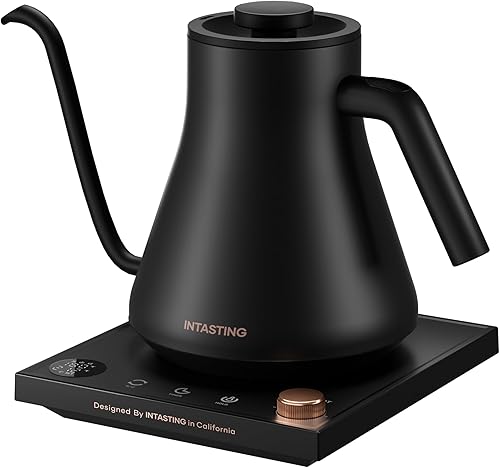
The INTASTING gooseneck kettle has surged in popularity in recent months, with 1,000+ units sold per month and a 4.5-star rating across 410+ reviews. It occupies an interesting position in the market — degree-by-degree temperature control like the premium kettles, a slightly larger 0.9L capacity, and a price point that undercuts most of its direct competitors.
The ±1°F temperature precision works well in practice. The stainless steel interior keeps water pure-tasting, and the quick-heating element brings water to temperature efficiently. The 0.9L capacity is a genuine advantage for Chemex and larger-batch brewing — you get roughly 100ml more than the 0.8L standard, which is exactly the margin that determines whether you need one fill or two for a full Chemex brew.
Design-wise, the INTASTING is attractive without being showy. The matte black finish is the current standard in the category, and the overall build quality is solid. The gooseneck spout provides good flow control — consistent, predictable, and appropriately thin for pour over work. The base provides a stable platform with a clean LCD temperature readout.
The trade-off is in the heating element: at 1000W versus the 1200W found in the COSORI and Mecity, the INTASTING takes slightly longer to reach temperature — approximately 5–7 minutes to reach a full boil versus 3–5 minutes. For a morning routine where you're grinding beans and setting up your dripper while the kettle heats, this rarely matters. But if speed is a priority, the 1200W options have a meaningful edge.
With strong early reviews and aggressive pricing, the INTASTING represents a compelling mid-range option — especially for brewers who want the larger 0.9L capacity and degree-level precision without the $200 Fellow Stagg price tag.
Pros
- ±1°F temperature precision at a mid-range price
- 0.9L capacity — larger than most competitors
- Stainless steel interior with no plastic water contact
- Clean design with intuitive LCD display
- 1,000+ monthly sales show strong market traction
Cons
- 1000W heating element is slower than 1200W alternatives
- Relatively new product — limited long-term reliability data
- 410 reviews is a smaller sample size than established picks
Best for: Chemex brewers who need the extra capacity, and anyone who wants degree-level temperature control at a reasonable price without the established brand premium.
Check Price on Amazon6. Bodum Melior Gooseneck Kettle — Best Minimalist Design

The Bodum Melior is essentially the Bistro's more refined sibling — same Bodum DNA, same reliable performance, but wrapped in a brushed stainless steel finish that looks genuinely elegant on a kitchen counter. At $36, it's actually cheaper than the Bistro, making it one of the best values in the entire gooseneck kettle category. With 13,000+ reviews at a 4.4-star average, it's proven itself over years of market presence.
Like the Bistro, the Melior is a boil-only kettle — no temperature presets, no digital display, no app connectivity. You press the switch, it heats to boiling, and it shuts off. For pour over, you wait 30–60 seconds after boiling and pour. For tea, you wait longer depending on the variety. This simplicity is either a limitation or a feature, depending on your perspective — and based on the 13,000+ positive reviews, a lot of people appreciate the lack of complexity.
The brushed stainless steel finish is what sets the Melior apart aesthetically. Where the Bistro's matte black is attractive but common, the Melior's steel finish has a timeless, professional quality that pairs well with virtually any kitchen aesthetic. It's the kind of kettle that guests notice and comment on — not because it screams for attention, but because it looks like it belongs.
Functionally, the Melior matches the Bistro: 27-ounce (0.8L) capacity, 1000W heating element, reliable gooseneck spout for controlled pours, and solid construction. The handle ergonomics are comfortable for extended pours, and the overall weight feels balanced and controllable. Auto-shutoff and boil-dry protection are included.
At $36, the Melior is the least expensive kettle on this list — and given the Bodum brand backing, the attractive design, and the massive review base confirming reliability, it's an outstanding entry point for anyone who wants to try pour over without a significant financial commitment.
Pros
- Lowest price on this list — outstanding value
- Beautiful brushed stainless steel finish
- Bodum brand reliability with 13,000+ reviews
- Clean, minimalist design that ages well
- Dead-simple operation — zero learning curve
Cons
- No temperature control — boil-only operation
- 1000W heating element — slower than 1200W models
- No hold/keep-warm function
- Stainless finish shows water spots more than matte black
Best for: Design-conscious buyers on a tight budget, minimalists who don't want another device with buttons and screens, and pour over newcomers who want a beautiful, reliable kettle from a trusted brand at a rock-bottom price.
Check Price on Amazon7. COSORI Smart Gooseneck Kettle — Best App-Connected
COSORI's Smart Gooseneck Kettle takes everything that works about their original model and adds what many home brewers have been asking for: degree-by-degree temperature control (±1°F) and app connectivity via the VeSync app. With 2,100+ reviews at a 4.5-star average, it's carved out a niche as the smart kettle that actually works without requiring a PhD in IoT troubleshooting.
The app integration is the distinguishing feature, and it's more practical than it sounds. Through the VeSync app (available on iOS and Android), you can set precise temperatures, create custom presets for different brew methods, schedule heating times, and monitor temperature in real time from across the house. The "schedule heating" feature is genuinely useful: set the kettle to reach 203°F at 6:30 AM, and your water is ready when you stumble into the kitchen. It also works with Alexa and Google Assistant for voice control — "Hey Alexa, set my kettle to 200 degrees" is a legitimate time-saver when your hands are occupied with a grinder.
On the kettle itself, the hardware matches the original COSORI: 0.8L capacity, 1200W heating, 100% stainless steel interior, and the same well-designed gooseneck spout. The difference is in the control interface — where the original has five preset buttons, the Smart model has a streamlined control panel with precise temperature setting. The 60-minute temperature hold function is maintained.
The upgrade from preset temperatures to ±1°F precision is meaningful for serious pour over brewing. Being able to set exactly 201°F (widely considered the sweet spot for medium-roast V60 brewing) versus choosing between the original's 185°F and 212°F presets is a genuine improvement in brew consistency. The fact that this precision costs the same $63 as the preset-only original makes the Smart model increasingly difficult to argue against.
The only real downside is the app dependency for some features. The kettle works fine standalone for basic temperature setting and boiling, but scheduling and custom presets require the VeSync app — and like all IoT products, you're trusting a third-party company to maintain their app and servers indefinitely. For a kettle, this is a lower-stakes concern than, say, a smart lock, but it's worth noting.
Pros
- ±1°F degree-by-degree temperature control
- App connectivity with scheduling, custom presets, and voice control
- Same price as the preset-only COSORI original
- 1200W fast heating with 60-minute hold
- Works with Alexa and Google Assistant
- 2,100+ reviews at 4.5 stars
Cons
- Scheduling requires VeSync app — IoT dependency
- 0.8L capacity is standard but limiting for large brews
- App setup has a learning curve for non-tech-savvy users
- WiFi connectivity can occasionally be finicky
Best for: Smart home enthusiasts who want voice control and scheduling, and anyone who wants COSORI's proven hardware with the upgrade to precise temperature control. If you're choosing between this and the COSORI original, the Smart model is the better buy at the same price.
Check Price on AmazonElectric Gooseneck Kettle Buying Guide
All gooseneck kettles look similar, but the differences between a good one and a great one become obvious the moment you start pouring. Here's what actually matters when choosing yours.
Spout Design — The Whole Point
The gooseneck spout is the reason this product category exists. A well-designed spout produces a smooth, laminar flow that you can control from a thin trickle to a moderate stream without turbulence, dripping, or sputtering. Poor spout design creates an uneven or splashy pour that makes consistent extraction difficult. When reading reviews, pay attention to comments about pour smoothness — this is the single most important factor and the one most affected by manufacturing quality.
Temperature Control: Presets vs. Precision
There are three tiers of temperature control in electric gooseneck kettles:
- Boil-only: Heats to 212°F and shuts off. You control temperature by waiting after boiling. Cheapest option, perfectly functional for pour over if you're patient.
- Preset temperatures: 3–5 fixed temperature options (typically 160°F, 175°F, 185°F, 200°F, 212°F). Covers most brewing scenarios without overthinking it.
- Degree-by-degree (±1°F): Set any specific temperature you want. Essential for competition-level brewing, nice-to-have for serious home enthusiasts, unnecessary for most casual brewers.
The honest truth: most home brewers will produce indistinguishable cups at 200°F versus 203°F. Preset kettles are more than sufficient for 90% of users. Degree-level precision matters most when you're dialing in a specific single-origin coffee and can taste the difference a few degrees makes — which, with practice, you actually can.
Capacity: 0.8L vs 0.9L vs 1L
Most gooseneck kettles range from 0.8L to 1L. For a single V60 or Kalita Wave brew (300–350ml), any capacity works. For a Chemex (600–700ml), you'll want 0.9L or larger to avoid mid-brew refills that disrupt your pour timing and drop your temperature. For back-to-back brews or multiple cups, 1L provides the most flexibility — but larger kettles are heavier during extended pours, which can lead to arm fatigue and less precise flow control.
Wattage: How Fast Do You Need Boiling Water?
1200W kettles reach boiling in approximately 3–5 minutes. 1000W kettles take 5–7 minutes. The practical difference is roughly 2 minutes — meaningful if you're in a rush, irrelevant if you're grinding beans and preparing your dripper during the heating phase. Don't overpay for wattage alone; it's the least important spec in this category.
Material: Stainless Steel Interior Is Non-Negotiable
The interior of your kettle should be 100% stainless steel. Any plastic in contact with heated water risks both off-flavors and chemical leaching over time. All seven kettles on this list have stainless steel interiors — this was a qualifying criterion for inclusion, not a bonus feature.
Temperature Guide for Different Brew Methods
One of the biggest advantages of a variable-temperature gooseneck kettle is the ability to optimize water temperature for your specific brewing method and coffee roast level. Here's a reference guide based on specialty coffee industry standards and SCA (Specialty Coffee Association) guidelines:
| Brew Method | Light Roast | Medium Roast | Dark Roast |
|---|---|---|---|
| Pour Over (V60, Kalita) | 205–210°F | 200–205°F | 195–200°F |
| Chemex | 205–210°F | 200–205°F | 195–200°F |
| French Press | 205–210°F | 200–205°F | 195–200°F |
| AeroPress | 200–210°F | 185–205°F | 175–195°F |
| Green Tea | 160–180°F | ||
| Black Tea | 200–212°F | ||
| Oolong Tea | 180–200°F | ||
| White Tea | 160–185°F | ||
The SCA's recommended brewing temperature range for coffee is 200 ± 2°F (93.0 ± 1°C). Within that window, lighter roasts benefit from hotter water (more energy needed to extract the denser, less-developed cell structure), while darker roasts extract more readily and can turn bitter or ashy with water that's too hot.
A practical tip: if you have a boil-only kettle, bring water to a full boil and then wait 30–45 seconds for medium roast, 60 seconds for dark roast, or pour immediately off-boil for light roast. A thermometer helps during the learning phase, but most experienced brewers develop an intuitive sense of timing within a few weeks.
FAQ
Do I really need a gooseneck kettle for pour over?
Technically no — you can pour from any vessel. But practically, yes. The difference in pour control between a gooseneck and a standard kettle is dramatic. A standard spout produces an uncontrollable gush that creates channels in your coffee bed, leading to uneven extraction (bitter spots next to sour spots). A gooseneck gives you a thin, precise stream that allows for even saturation. If you're investing in pour over equipment, the kettle is the piece that makes the biggest difference in consistency.
Is the Fellow Stagg EKG Pro worth $200?
It depends on what you value. The Stagg's pour control is genuinely best-in-class — the spout design is superb. The build quality is premium. The aesthetics are beautiful. But for pure brewing functionality, the Mecity and COSORI Smart offer ±1°F temperature precision at $56–63. You're paying a significant premium for the Fellow's spout refinement, design quality, and brand. If coffee is your hobby and you'll use the kettle daily for years, the per-use cost becomes quite reasonable. If you're brewing casually, the COSORI delivers 90% of the experience at 30% of the price.
How important is variable temperature control?
Important for optimization, not essential for great coffee. The difference between pouring at 200°F and 205°F is detectable in a side-by-side comparison, but both temperatures produce good coffee. Preset temperatures (like the COSORI original's five options) cover the vast majority of brewing scenarios. Degree-by-degree control matters most when you're dialing in a specific single-origin bean and want to maximize its unique flavor profile — which is a real pursuit for specialty coffee enthusiasts but unnecessary for someone who wants a reliably good morning cup.
What's the ideal capacity for a pour over gooseneck kettle?
For a single V60 or Kalita Wave brew (one cup, ~300–350ml of water), any capacity works. For a full Chemex (3–4 cups, ~600–700ml), you'll want 0.9L or larger to avoid mid-brew refills. For households that brew multiple cups sequentially, a 1L kettle provides the most flexibility. Be aware that larger capacity means a heavier kettle, which affects pour control during extended pours — this is why most specialty kettles top out at 0.9–1.0L rather than the 1.5–1.7L common in standard electric kettles.
Can I use a gooseneck kettle for tea?
Absolutely — and it's arguably an even better upgrade for tea than for coffee. Different tea types require dramatically different temperatures (160°F for green tea up to 212°F for black tea), and a variable-temperature gooseneck kettle lets you hit these targets precisely. The controlled pour is also beneficial for gongfu-style brewing, where you're pouring into small vessels and precision matters. Several of the kettles on this list (especially the COSORI original with its 140°F preset) were explicitly designed with tea brewing in mind.
Electric gooseneck vs. stovetop gooseneck — which is better?
Electric wins for convenience and temperature accuracy. Stovetop gooseneck kettles (like the beloved Hario Buono and Kalita stovetop models) are cheaper, have no electronics to fail, and work with any heat source — but they require a separate thermometer for temperature precision and take longer to heat. If you have an induction cooktop, a stovetop gooseneck paired with a good thermometer can match an electric kettle's precision. For everyone else, electric is the practical choice for daily use.
How do I clean an electric gooseneck kettle?
Monthly descaling with a 1:1 mixture of white vinegar and water (fill halfway, boil, let sit 20 minutes, rinse thoroughly) prevents mineral buildup. For daily cleaning, simply rinse with hot water — soap is unnecessary and can leave residue. Never submerge the base or power connector in water. If you have hard water, descale every 2–3 weeks to maintain heating efficiency and prevent scale flakes in your brew.