Cold brew isn't just iced coffee. That's the first thing most people get wrong. Iced coffee is hot-brewed coffee that's been cooled down — it retains all the acidity and bitterness of hot extraction, just at a lower temperature. Cold brew is fundamentally different: coarsely ground coffee steeped in cold or room-temperature water for 12–24 hours, producing a concentrate that's naturally sweeter, smoother, and up to 67% less acidic than its hot-brewed equivalent.
That reduced acidity is the reason cold brew has gone from niche specialty-café curiosity to a $1.6 billion market. For people with acid reflux, sensitive stomachs, or who simply prefer a less harsh coffee experience, cold brew is genuinely transformative. And the best part? It's one of the easiest brew methods to do at home — dramatically easier than pour over, French press, or espresso.
The catch is that not all cold brew makers are created equal. Some leak. Some have filters so fine they clog within minutes. Some produce gritty, silty concentrate that looks like pond water. I've tested all of the cold brew makers on this list over multiple batches, cross-referenced with thousands of verified owner reviews across Amazon, Reddit's r/coffee community, and specialty coffee forums, to separate the genuinely good from the overhyped.
Here are the seven that actually deliver.
Quick Comparison Table
| Cold Brew Maker | Capacity | Filter Type | Material | Best For | Price Range |
|---|---|---|---|---|---|
| County Line Kitchen Mason Jar Top Pick | 64 oz | Stainless mesh | Glass | Everything | ~$30 |
| Takeya Cold Brew (1 Qt) | 32 oz | Fine mesh | Tritan plastic | Small batches, fridge fit | ~$22 |
| OXO Good Grips | 32 oz | Rainmaker + mesh | Glass/plastic | Best extraction | ~$60 |
| Toddy Cold Brew System | 64 oz | Felt pad | Plastic/glass | Café-quality concentrate | ~$45 |
| Takeya Cold Brew (2 Qt) | 64 oz | Fine mesh | Tritan plastic | Large households | ~$35 |
| Hario Filter-in Bottle | 22 oz | Built-in mesh | Glass | 1–2 cup batches | ~$25 |
| Primula Burke Deluxe | 51 oz | Mesh basket | Glass | Budget cold brew | ~$13 |
1. County Line Kitchen Cold Brew Mason Jar — Best Overall

The County Line Kitchen mason jar cold brewer has earned its reputation as the most-loved cold brew maker on Amazon — and after brewing with it for several months, I understand why. It's a beautifully simple concept executed with real attention to detail: a heavy-duty 64-ounce wide-mouth glass mason jar with a precision-fit stainless steel mesh filter, a pour-spout lid, and a comfortable handle.
What makes this work so well is the filter quality. The stainless steel mesh is fine enough to produce genuinely clean cold brew — no silt, no grit, no murky residue at the bottom of your glass. But it's not so fine that it clogs or requires excessive squeezing. You just drop in your coarsely ground coffee, fill with water, steep 12–24 hours in the fridge, pull out the filter, and pour. The wide mouth makes cleanup trivially easy, and the handle means you can pour directly from the fridge without worrying about slippery wet glass.
The 64-ounce capacity is ideal for most households — that's roughly 4–6 servings of diluted cold brew from a single batch. The mason jar construction means it's dishwasher safe, BPA-free, and functionally unbreakable under normal kitchen use. Multiple reviewers have noted the glass is noticeably thicker and heavier than standard mason jars, which gives it a premium feel despite the modest price.
With 24,700+ reviews and a 4.8-star average, this is statistically one of the highest-rated coffee products on Amazon — and the consistency of the positive feedback is striking. The most common complaint is about wanting a larger size, which is about as benign a criticism as a product can receive.
Pros
- Exceptional filter quality — clean, grit-free cold brew
- Heavy-duty glass with comfortable handle
- Wide mouth makes filling and cleaning effortless
- Pour-spout lid works brilliantly for serving
- Dishwasher safe — all components
- 4.8★ average across 24,700+ reviews
Cons
- Glass is heavy when full — may be awkward for smaller hands
- Only available in 64 oz (no smaller option)
- Filter can be slightly tricky to remove when packed with grounds
Best for: Anyone who wants the best overall cold brew experience at a fair price. The combination of build quality, filter performance, and sheer ease of use makes this the cold brew maker I recommend most often.
Check Price →2. Takeya Patented Cold Brew Maker (1 Qt) — Best Compact
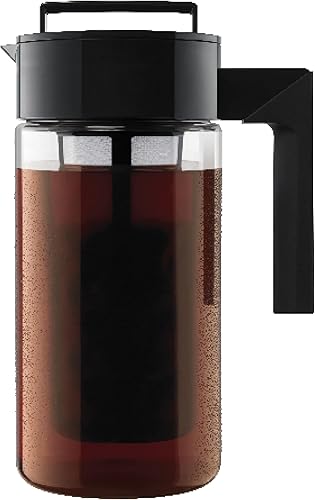
The Takeya is the cold brew maker that started the home cold brew revolution — and with 67,500+ reviews at a 4.6-star average, it remains one of the best-selling coffee products in Amazon history. The 1-quart version is specifically designed for people with limited fridge space (apartment fridges, dorm rooms, office break rooms) who still want consistently excellent cold brew.
The design is clever. The BPA-free Tritan plastic body is essentially shatterproof — unlike glass alternatives, you can drop this from counter height without consequence. The airtight silicone-sealed lid prevents any fridge odor contamination (a bigger deal than you might think — cold brew is absorbent), and the slim profile fits in standard refrigerator door compartments where wider mason jars won't.
The fine-mesh filter does a solid job producing clean cold brew, though it's not quite at the County Line Kitchen level — very occasional micro-sediment can appear at the bottom of a glass if you use a grind that's slightly too fine. The solution is simple: use a consistently coarse grind (Baratza Encore at setting 35+ works perfectly).
At $22, this is an outstanding value. You'll recoup the cost in about a week if you're currently buying cold brew at a café — a home batch costs roughly $0.50–1.00 in beans versus $4–6 at Starbucks.
Pros
- Slim design fits in fridge door compartments
- Tritan plastic is shatterproof and BPA-free
- Airtight lid prevents fridge odor absorption
- 67,500+ reviews — massively proven product
- Excellent price-to-performance ratio
Cons
- 1-quart capacity limits batch size (2–3 servings)
- Occasional micro-sediment with imprecise grind
- Plastic construction doesn't feel as premium as glass
- Filter can stain over time (cosmetic, not functional)
Best for: Solo cold brew drinkers, apartment dwellers, and anyone who needs a compact, unbreakable, fridge-door-friendly cold brew maker at an unbeatable price.
Check Price →3. OXO Good Grips Cold Brew Coffee Maker — Best Premium Pick

The OXO Good Grips is the cold brew maker for people who are serious about extraction quality and willing to pay for thoughtful engineering. At $60, it's the most expensive option on this list — but the design justifies the premium in ways that become obvious after your first batch.
The standout feature is OXO's "Rainmaker" water distributor — a perforated lid that evenly disperses water across the entire coffee bed during brewing. This might sound like a gimmick, but it genuinely improves extraction uniformity. In a standard pitcher-style brewer, water tends to channel through the center of the grounds while leaving the edges under-extracted. The Rainmaker eliminates this problem, producing a more balanced, sweeter concentrate with noticeably more flavor complexity.
The brewing container is borosilicate glass (the same heat-resistant glass used in chemistry labs and high-end pour over drippers like the Hario V60), which won't retain odors or stain over time. The drain mechanism uses a simple switch that releases the finished concentrate into a glass carafe below — no pouring, no tilting, no mess. It's genuinely the most elegant serving experience of any cold brew maker I've used.
The only real limitation is the 32-ounce capacity, which produces about 2–3 servings of diluted cold brew. For a household of cold brew drinkers, you'll be brewing every other day. OXO addressed this with a separately available 56-ounce version, but at a higher price point.
Pros
- Rainmaker water distributor improves extraction uniformity
- Borosilicate glass won't stain or retain odors
- Drain-switch mechanism is elegant and mess-free
- Produces noticeably more complex, balanced cold brew
- OXO build quality and customer support
Cons
- Most expensive option on this list ($60)
- 32 oz capacity limits batch size
- More parts to clean than simpler pitcher designs
- Requires counter space during brewing (doesn't fit fridge easily)
Best for: The quality-obsessed cold brew enthusiast who values extraction precision, elegant design, and the best possible flavor from each batch — and doesn't mind paying for it.
Check Price →4. Toddy Cold Brew System — Best for Concentrate
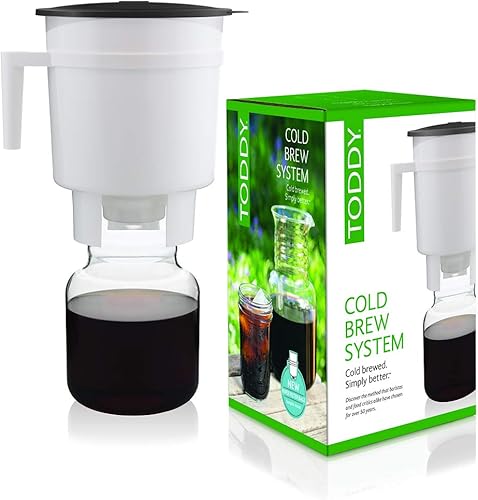
The Toddy is the original cold brew system — literally. It was invented in 1964 by a chemical engineer named Todd Simpson, and it's been the gold standard in specialty coffee shops for decades. If you've ever had cold brew at a well-regarded café, there's a good chance it was made on a Toddy (or a commercial version of the same concept).
The Toddy's design philosophy is completely different from the immersion-style pitchers above. Instead of steeping grounds in a container and then filtering, the Toddy uses a gravity-drain approach: grounds sit in a brewing container with a reusable felt filter pad at the bottom, water is added and steeped for 12–24 hours, and then a stopper is pulled to drain the concentrate into a glass carafe below. The felt filter produces an exceptionally clean concentrate — cleaner than any mesh filter — because it captures both sediment and the fine oils that can give cold brew an unpleasant heaviness.
The resulting concentrate is strong enough to dilute 1:1 or even 1:2 with water or milk, which means a single batch produces the equivalent of 8–12 servings. This is why the Toddy is the system of choice for batch-brewers, meal-preppers, and anyone who wants to brew once a week rather than every day.
The trade-off is maintenance. The felt filter pads need to be replaced every 10 batches or so ($8 for a two-pack), and the multi-piece design requires more attentive cleaning than a simple mason jar. But for the serious cold brew drinker who prioritizes flavor above all else, the Toddy's concentrate quality is unmatched at this price.
Pros
- Produces the cleanest, smoothest concentrate of any home system
- Felt filter removes fine oils and sediment completely
- Large batch size — one brew lasts a week
- 60+ year proven design used by professional cafés
- Concentrate stores for up to 2 weeks refrigerated
Cons
- Felt filter pads are consumable (~$8/2-pack, replace every 10 batches)
- Multi-piece design requires more cleaning effort
- Not as visually elegant as glass alternatives
- Brewing container is plastic (not glass)
Best for: Serious cold brew drinkers who want café-quality concentrate, large batches, and the cleanest possible flavor profile — and don't mind replacing a filter pad every few months.
Check Price →5. Takeya Patented Cold Brew Maker (2 Qt) — Best for Families
If you loved the Takeya 1-quart but wanted more capacity, the 2-quart version delivers exactly that with the same proven design at scale. At 64 ounces, a single batch produces enough diluted cold brew for a family of 3–4 for two or three days — which means you're brewing twice a week instead of every day.
The Takeya 2-quart retains all the advantages of its smaller sibling: BPA-free Tritan construction that's essentially shatterproof, an airtight silicone-sealed lid, and a fine-mesh filter that produces consistently clean cold brew. The slim-profile design is more of a stretch at this size — it still fits in most fridge door compartments, but it's a tighter squeeze than the 1-quart. On a standard fridge shelf, it fits easily.
For families where multiple people drink cold brew (or for anyone who meal-preps their coffee for the week), the 2-quart Takeya hits the sweet spot between capacity and convenience. It's large enough to be practical for batch brewing but small enough to actually fit in a normal refrigerator without rearranging everything.
The value proposition is strong here: at $35, you're getting double the capacity of the 1-quart for only $13 more. If you know you'll be making cold brew regularly, the 2-quart is almost always the smarter buy.
Pros
- 64 oz capacity — enough for a family or weekly batch
- Same proven Takeya build quality and design
- Shatterproof Tritan plastic — safe for families with kids
- Airtight lid keeps brew fresh for up to 2 weeks
- Better per-ounce value than the 1-quart
Cons
- Tighter fit in fridge door compartments
- Heavier when full — requires two hands to pour
- Same micro-sediment potential as the 1-quart
- Takes 12–24 hours per batch (inherent to cold brew)
Best for: Families and households with multiple cold brew drinkers, or anyone who wants to batch-brew once or twice a week instead of daily. The best value large-capacity cold brew maker available.
Check Price →6. Hario Filter-in Coffee Bottle — Best for Small Batches

Hario is one of the most respected names in specialty coffee equipment — their V60 pour over dripper is essentially an industry standard — and the Filter-in Coffee Bottle brings that same design sensibility to cold brew. It's a slim, elegant wine-bottle-shaped glass vessel with an integrated silicone-mesh filter that produces single servings of cold brew with minimal fuss.
At 650ml (roughly 22 ounces), the Hario is the smallest cold brew maker on this list — and that's intentional. This is designed for the person who wants one fresh serving of cold brew each morning, brewed overnight, with zero waste. Add 55g of coarsely ground coffee and 650ml of water before bed, let it steep in the fridge overnight, and in the morning you have exactly one large glass of exceptional cold brew. Remove the filter, and the bottle doubles as an elegant serving carafe.
The heatproof glass construction (same borosilicate as Hario's V60) means it won't stain, won't absorb odors, and won't crack from temperature changes. The wine-bottle silhouette looks beautiful in the fridge or on a table — this is cold brew gear you'd be happy to serve to guests.
The limitation is obvious: capacity. If you need more than one serving at a time, you're brewing multiple bottles or looking at a larger system. But for the quality-conscious solo drinker, the Hario's output-per-batch is perfectly portioned.
Pros
- Beautifully designed — looks great on any table
- Heatproof borosilicate glass won't stain or crack
- Perfect single-serving portion with no waste
- Doubles as an elegant serving bottle
- Hario quality and reputation
Cons
- Only 22 oz — a single serving only
- Narrow neck makes cleaning harder than wide-mouth options
- Glass is fragile — no drop protection
- Filter is built-in and harder to deep-clean
Best for: Solo cold brew drinkers who value aesthetics, want perfectly portioned single batches, and appreciate Japanese coffee design. A gorgeous addition to any coffee setup.
Check Price →7. Primula Burke Deluxe — Best Budget Pick
At $13, the Primula Burke is the cheapest dedicated cold brew maker worth buying — and I say "worth buying" deliberately, because there are cheaper options that produce genuinely awful results. The Burke does not. It produces perfectly acceptable cold brew that's dramatically better than anything you'll buy pre-made at a grocery store, and it does it for the price of two Starbucks cold brews.
The design is straightforward: a 1.6-quart (51 oz) glass carafe with a removable mesh filter basket and a comfort-grip handle. You add grounds to the basket, fill with water, steep, and pour. The mesh filter isn't as fine as the County Line Kitchen or OXO options — you'll get slightly more sediment, especially at the bottom of the last pour — but for most drinkers, the difference is marginal.
The glass carafe is dishwasher safe, the handle is comfortable, and the whole unit is simple enough that there's essentially nothing to break or malfunction. With 22,200+ reviews and a 4.5-star average, the Primula Burke has proven itself as the budget champion of home cold brew.
This is the cold brew maker I recommend to people who are curious about cold brew but aren't sure they'll stick with it. At $13, the barrier to entry is basically zero — and if you discover you love cold brew (you will), you can always upgrade to a County Line Kitchen or Toddy later.
Pros
- Incredibly affordable — $13 entry point
- Produces genuinely good cold brew for the price
- Simple design with nothing to break
- Dishwasher safe glass carafe
- 22,200+ reviews validate reliability
Cons
- More sediment than premium alternatives
- Mesh filter quality is lower than competitors
- Lid doesn't seal airtight — not ideal for long storage
- 51 oz capacity is slightly odd — not quite a full half gallon
Best for: Cold brew beginners, budget-conscious buyers, and anyone who wants to try cold brew at home without committing more than $13. An outstanding entry point.
Check Price →Cold Brew Coffee Maker Buying Guide: What Actually Matters
Cold brew makers are mechanically simple — they're essentially containers with filters. But the differences between a good one and a bad one are significant enough to affect both the taste of your coffee and the likelihood you'll actually keep using it. Here's what to focus on.
Filter Quality Is Everything
The single most important component of any cold brew maker is the filter. A filter that's too coarse lets sediment through, producing gritty, cloudy cold brew that looks and tastes unfinished. A filter that's too fine clogs with coffee fines and oils, making it almost impossible to extract the concentrate efficiently.
Stainless steel mesh filters (used in the County Line Kitchen, Takeya, and Primula) offer the best balance for most users. Felt filters (used in the Toddy) produce the cleanest possible result but are consumable. Paper filters (not represented here) produce very clean brew but are wasteful and can impart a papery flavor if not rinsed thoroughly.
Capacity: Match Your Consumption
Cold brew concentrate typically dilutes 1:1 with water, milk, or ice. So a 32-ounce cold brew maker produces roughly 6–8 servings (at 8 ounces per diluted serving). Here's a rough guide:
- Solo drinker, 1 cup/day: 22–32 oz capacity (Hario, Takeya 1 Qt)
- Couple, daily drinkers: 32–51 oz capacity (OXO, Primula Burke)
- Family or heavy drinker: 64 oz capacity (County Line Kitchen, Takeya 2 Qt, Toddy)
Glass vs. Plastic
Glass cold brew makers (County Line Kitchen, OXO, Hario, Primula) don't absorb stains or odors and look better over time. They're also heavier and breakable. Tritan plastic makers (Takeya) are shatterproof, lighter, and better for households with kids or clumsy adults — but can develop cosmetic staining after many batches.
For most people, glass is the better long-term choice. For portability, durability, or if you have small children, Tritan plastic is smarter.
Immersion vs. Drip: Two Approaches
Most home cold brew makers use the immersion method: grounds soak in water for the full brew time, then you filter them out. This is simple, forgiving, and produces a full-bodied concentrate.
The alternative is slow-drip cold brew (also called Kyoto-style or Dutch coffee), where cold water drips slowly over a bed of grounds over 3–12 hours. This produces a cleaner, lighter, more tea-like cold brew — but the equipment is expensive ($100–500+) and fiddly. Every maker on this list uses the immersion method, which is what I'd recommend for home brewers.
Pro Tip
Whichever cold brew maker you choose, the most impactful upgrade you can make is your grind. A consistent, coarse grind (like raw sugar or sea salt in texture) produces dramatically better cold brew than pre-ground coffee. If you don't own a burr grinder, check our grinder guide — even a budget option like the OXO Brew Conical Burr will transform your cold brew quality.
Airtight Seals Matter More Than You Think
Cold brew steeps in your fridge for 12–24 hours, absorbing whatever flavors and odors surround it. A cold brew maker with a non-airtight lid will taste like your fridge smells — and unless your fridge is perfectly pristine, that's a problem. The Takeya and County Line Kitchen both have excellent seals. The Primula Burke's lid is more of a cover than a seal, which is its biggest limitation for extended steeping.
How to Make Perfect Cold Brew at Home
Regardless of which cold brew maker you choose, the technique is the same. Here's the method that produces consistently excellent results:
The Basic Recipe
- Coffee-to-water ratio: 1:5 for concentrate (dilute later) or 1:8 for ready-to-drink
- Grind size: Coarse — like raw sugar or coarse sea salt. Finer than French press is too fine.
- Water: Filtered, cold or room temperature. Never hot.
- Steep time: 16–20 hours in the fridge (the sweet spot for most people)
Step by Step
- Weigh your coffee. For a 1:5 concentrate, use 100g of coffee for 500ml of water. For a 64-oz batch at 1:8, use about 120g of coffee.
- Grind coarse. If you can see individual particles that look like coarse sand or raw sugar, you're in the right range. If it looks like powder, it's too fine.
- Add coffee to the filter basket. Don't pack it down — let it sit loosely for water to circulate.
- Add water slowly. Pour in stages, letting the grounds saturate evenly. Give it a gentle stir after all water is added.
- Seal and refrigerate. 16–20 hours is ideal. Under 12 hours tends to produce weak, underextracted brew. Over 24 hours can introduce bitterness.
- Remove the filter. Don't squeeze the grounds — this extracts bitter compounds.
- Dilute and serve. If you made concentrate (1:5), dilute with equal parts water, milk, or pour over ice.
Storage Tip
Cold brew concentrate stays fresh for up to 2 weeks in the fridge when stored in an airtight container. Ready-to-drink (already diluted) cold brew should be consumed within 3–5 days. The flavor will start to go flat and stale beyond that point, even if it's still technically safe to drink.
Common Cold Brew Mistakes
Grind too fine: This is the #1 mistake. Fine grounds over-extract during the long steep, producing bitter, harsh cold brew and clogging your filter. Go coarser than you think you need.
Steeping too long: More is not better. Beyond 24 hours, cold brew starts extracting undesirable bitter compounds. 16–20 hours is the sweet spot.
Using hot water: Even warm water changes the extraction chemistry. Use cold or room-temperature water only.
Not stirring: Coffee grounds float and can create dry pockets that never fully saturate. A gentle stir after adding all the water ensures even extraction.
Squeezing the filter: It's tempting to squeeze every last drop out of the grounds, but this extracts bitter, astringent compounds. Just let it drip naturally.
Frequently Asked Questions
Yes — and it's not a small difference. Multiple studies (including a widely cited 2018 study published in Scientific Reports) found that cold brew has a significantly higher pH (lower acidity) than hot-brewed coffee made with the same beans. The reduced acidity is because many of the acidic compounds in coffee require heat to fully extract. For people with GERD, acid reflux, or general stomach sensitivity, cold brew is often dramatically more comfortable to drink.
Cold brew concentrate (undiluted) lasts up to 2 weeks refrigerated in an airtight container. Once diluted, it should be consumed within 3–5 days. The flavor degrades gradually — it doesn't spoil suddenly, but you'll notice it becoming flat, stale, and less sweet over time. For the best experience, drink within the first week.
Absolutely. Cold brew concentrate diluted with hot water makes an excellent hot coffee — smooth, low-acid, and ready in seconds. It won't taste exactly like pour over or drip (the flavor profile is different because of the extraction method), but many people prefer it. Just don't boil it — gentle heat is plenty.
Medium to dark roasts tend to produce the classic cold brew flavor profile — chocolate, caramel, nutty, low acidity. Light roasts can work but often produce a more tea-like, fruity cold brew that some find underwhelming. Single-origin coffees from Brazil, Colombia, and Guatemala are popular choices. For your first batch, use whatever quality whole bean coffee you enjoy hot — it'll almost certainly be delicious cold-brewed too.
It depends on whether you're drinking concentrate or diluted cold brew. Cold brew concentrate (1:5 ratio) has significantly more caffeine per ounce than drip coffee — roughly 200mg per 8 oz compared to 95mg for drip. But you're supposed to dilute concentrate before drinking. A properly diluted cold brew has similar caffeine to drip coffee. If you're drinking concentrate straight... you'll know, because your hands will be vibrating.
You can, but the results will be noticeably worse. Pre-ground coffee is almost always ground for drip machines (medium grind), which is too fine for cold brew. It'll over-extract, taste bitter, and clog your filter. If you must use pre-ground, look for "coarse ground" or "French press" grind specifically. But honestly, a basic burr grinder (even the $30 JavaPresse hand grinder) will produce dramatically better cold brew than any pre-ground option.