Let me be honest with you about home espresso from the jump: it is the most demanding and most rewarding thing you can do in your kitchen. Great espresso requires precise grind, precise dose, precise temperature, and decent technique. No machine under $500 — or under $1,500, honestly — does all of that automatically. There's a learning curve. Some days the shot will be terrible and you won't immediately know why.
That said, a solid machine in the $200–500 range, paired with a decent grinder and a few hours of practice, can produce espresso that rivals your local café. I've tasted shots from a Gaggia Classic Pro that were genuinely exceptional — bright, sweet, with a thick, persistent crema. That machine costs $450. The shots were better than most $5 lattes I've paid for.
This guide covers the six machines I'd actually recommend in this price range — their strengths, their weaknesses, and who they're right for.
Types of Espresso Machines Explained
Before the reviews, it helps to understand the three main types of home espresso machines and what each one requires from you:
Manual (Lever) Espresso Machines
You create the 9 bars of pressure yourself by pulling a lever. Maximum control, maximum skill requirement, no electronics involved. Beautiful to watch, steep learning curve. Not covered here — they belong in a separate guide.
Semi-Automatic Espresso Machines
A pump creates the pressure, but you control when extraction starts and stops. You dose, tamp, lock in the portafilter, start the pump, and stop it when done. This is the sweet spot for home baristas who want real control over their espresso. Most machines in this guide are semi-automatic.
Super-Automatic (Bean-to-Cup) Machines
Grinds, doses, tamps, and brews automatically. Push a button, get espresso. The tradeoff is limited adjustability — you can't dial in the way you can with a semi-auto — and the espresso quality ceiling is lower. For people who want convenience over quality, these make sense but are mostly out of the sub-$500 range.
Important: Budget for a Grinder Too
An espresso machine without a proper grinder is like a sports car with bald tires. If you're spending $300 on a machine, plan to spend at least $150–200 on a grinder. The Breville Barista Express has a built-in grinder (reviewed below) and is the one exception to this rule.
Quick Comparison Table
| Machine | Boiler | Portafilter | Best For | Price |
|---|---|---|---|---|
| Breville Bambino Plus Top Pick | Thermocoil | 54mm | Beginners + milk drinks | ~$500 |
| Gaggia Classic Pro | Single boiler | 58mm | Serious home baristas | ~$450 |
| De'Longhi Dedica EC685 | Thermoblock | 51mm | Small kitchens, simplicity | ~$200 |
| Breville Barista Express | Thermocoil | 54mm | All-in-one beginners | ~$700* |
| Rancilio Silvia | Single boiler | 58mm | Semi-pro, upgraders | ~$750* |
| De'Longhi Stilosa EC230 | Thermoblock | 51mm | True budget entry | ~$100 |
*The Barista Express and Rancilio Silvia slightly exceed $500 but are included because they're commonly found on sale within budget, and are frequently purchased in this category.
1. Breville Bambino Plus — Best Overall for Most People

The Bambino Plus is the machine I recommend most often to people who are serious about espresso but are newer to the craft. It threads the needle between approachability and real quality better than anything else in this price range.
The thermocoil heating system reaches brew temperature in 3 seconds — genuinely 3 seconds, not the "under a minute" that many competitors claim. The PID temperature control is accurate to ±1°C, which matters for consistent espresso. The 54mm portafilter is commercial-grade enough that your technique improvements actually show up in the cup.
The steam wand is automatic — it heats milk to your set temperature and stops, which takes a lot of the stress out of steaming. It's not as flexible as a manual wand, but the results for lattes and flat whites are consistently good, with microfoam quality that would cost you $6 at a café. This is the feature that differentiates it from the entry-level Bambino (non-Plus).
The grind: Breville's 54mm baskets pair best with the Breville Smart Grinder Pro or another grinder that doses into a 54mm basket directly. You don't get the same single-dosing flexibility you'd have with a 58mm portafilter machine, but for daily use it's fine.
Pros
- 3-second heat-up — fastest in class
- PID temperature control (±1°C)
- Auto-steam wand for consistent milk texture
- Compact footprint for a quality espresso machine
- Great shot quality for the price
Cons
- 54mm portafilter (fewer aftermarket accessories than 58mm)
- Auto-steam wand limits latte art practice vs manual wand
- At the top of the $500 budget — often $500 or slightly over
- No PID display for adjustments without disassembly
Best for: People who want quality espresso and latte drinks without a steep learning curve. Apartment brewers who don't want to wait 30 minutes for warm-up. Anyone who values convenience alongside quality.
Check Price →2. Gaggia Classic Pro — Best for Serious Home Baristas

The Gaggia Classic has been in production in some form since 1977. The Classic Pro (the current version since 2019) is one of the most respected espresso machines ever made under $1,000, and it's not hard to understand why once you pull your first shot.
The single boiler runs at commercial 9-bar pressure — not the 15 or 19 bars that many budget machines advertise (more is not better; 9 bar is the correct extraction pressure). The commercial-grade 58mm portafilter means every aftermarket basket, tamper, and bottomless portafilter on the market is compatible. The all-metal construction has the feel and durability of something that will outlast every piece of plastic in your kitchen.
The trade-off is patience. The Gaggia takes 8–10 minutes to fully heat-saturate before the first shot is consistent. The single boiler means you switch between brewing and steaming (a 30-second wait between operations). There's no automatic anything — you control the pump, the steam, the time. For some people, this ritual is part of the pleasure. For others, it's a genuine morning inconvenience.
The other trade-off is that the Classic Pro rewards investment in skill and equipment. With a quality grinder and proper dialing-in technique, it produces extraordinary espresso. Without those things, it just produces mediocre espresso faster than a cheaper machine would.
Pros
- Commercial-quality 9-bar pump (correct extraction pressure)
- Industry-standard 58mm portafilter
- All-metal, repair-friendly construction
- Exceptional shot quality when dialed in
- Huge mod community — many upgrades available
- Will last 15+ years with basic maintenance
Cons
- 8–10 minute warm-up for consistent shots
- Single boiler: wait between shots and steaming
- No PID stock (though affordable PID mod available)
- Steam wand requires manual technique to master
- Less beginner-friendly than Bambino Plus
Best for: Coffee enthusiasts who want to truly learn espresso, are comfortable with a learning curve, and want a machine they'll use for a decade. Also: anyone who enjoys tinkering (the mod community is excellent).
Check Price →3. De'Longhi Dedica EC685 — Best Compact Option
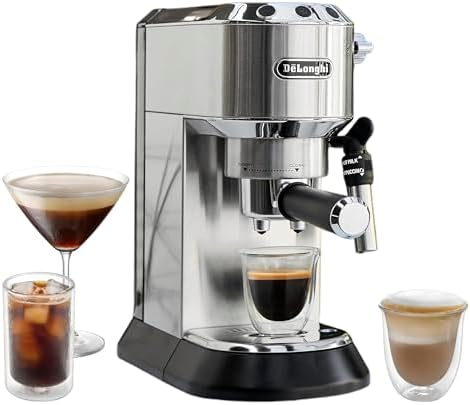
The Dedica is 6 inches wide. That is genuinely narrow — it fits in kitchen corners where nothing else will go. If counter space is your binding constraint, the Dedica wins by default.
Performance-wise, it's a capable machine for its price point. The thermoblock heats quickly (under 40 seconds), and with some modification — specifically, removing the rubber restrictor from the steam wand — it can produce decent microfoam for lattes. Out of the box, the pressurized portafilter filters makes it more forgiving of inconsistent grind but limits your control ceiling; you can swap in an unpressurized basket for better results with a quality grinder.
The 51mm portafilter is the main drawback. Fewer compatible baskets and accessories are available than for 54mm or 58mm machines, and some grinders won't dose directly into a 51mm basket. It works, but it's a less standard ecosystem.
Pros
- Extremely narrow — fits anywhere
- Fast heat-up (35–40 seconds)
- Good value for the price
- Pressurized baskets are forgiving for beginners
- Stylish, looks premium on the counter
Cons
- 51mm portafilter limits aftermarket options
- Stock steam wand is weak (restricted); needs modification
- Pressurized baskets cap quality ceiling
- Plastic construction feels lightweight
Best for: People with very limited counter space, beginners who want a simple entry to espresso, or anyone on a tight budget who wants a machine that actually produces real espresso (not just strong drip coffee).
Check Price →4. Breville Barista Express — Best All-in-One

The Barista Express solves the grinder problem by including a built-in conical burr grinder. You load beans in the top, set your dose and grind size, and the machine grinds directly into the portafilter. It's the most self-contained path to real espresso, which is why it's been a bestseller for years.
The integrated grinder is genuinely decent for espresso — it covers the fine range well and has 25 grind settings with a stepless adjustment dial for fine-tuning. It won't outperform a dedicated grinder like the Niche Zero, but for a single-machine all-in-one solution, it's surprisingly capable.
The machine side runs the same thermocoil heating and 54mm portafilter as the Bambino Plus. Steam wand is manual (requires technique, rewards practice). PID temperature control is accurate. The shot quality ceiling is real: with a good technique, you can pull excellent shots.
It technically exceeds $500 (usually $700, sometimes on sale for $600), but it's worth including here because it bundles machine + grinder, and comparable separate purchases would cost $700–900.
Pros
- Built-in burr grinder — one purchase, one countertop unit
- Beans-to-espresso in under 2 minutes
- PID temperature control
- Grinder quality sufficient for daily espresso
- Great beginner and intermediate machine
Cons
- Above the $500 budget (noted)
- Built-in grinder is harder to service or upgrade
- Large footprint
- Manual steam wand requires practice
- 54mm portafilter ecosystem
Best for: Anyone who wants a complete espresso setup in one machine and doesn't want to research, budget for, and manage a separate grinder. Excellent first machine.
Check Price →5. Rancilio Silvia — The Semi-Pro Classic

The Rancilio Silvia has been made in essentially the same form since 1997. It uses commercial-grade components throughout — the group head, portafilter, and basket are all pulled from Rancilio's commercial line — in a machine designed for home use. The result is a machine with the heat stability, the build quality, and the shot quality of something that costs twice as much.
Like the Gaggia Classic Pro, the Silvia is a single-boiler machine that requires a full warm-up cycle and patience between shots and steaming. It also requires a quality grinder — the Silvia's commercial group head and 58mm portafilter will expose every flaw in your grind. If you're not dialing in carefully, you'll make mediocre espresso more expensively than you would with a Bambino Plus.
The Silvia V6 (current version) added a PID controller that makes temperature management significantly easier — this was the Silvia's main weakness in older versions. With PID, temperature stability is excellent, and the shot quality ceiling is among the highest of any machine under $1,000.
Pros
- Commercial-grade components throughout
- 58mm commercial portafilter (maximum accessory compatibility)
- PID temperature control (V6 and newer)
- Extraordinary build quality — will outlast almost anything
- High shot quality ceiling
Cons
- Above the $500 budget
- 15+ minute warm-up for full heat saturation
- Single boiler — switching between brew and steam is slow
- Steep learning curve, unforgiving of grind inconsistency
Best for: Experienced home baristas who want commercial-grade build quality and shot potential, are committed to learning, and plan to use the machine for a decade or more.
Check Price →6. De'Longhi Stilosa EC230 — Best True Budget Pick

At $100, the Stilosa is the most accessible entry to real espresso. I'll be straight about what that means: it's a budget machine with budget limitations, but within those limitations, it works — and it's a significant step up from Nespresso or pod coffee.
The pressurized portafilter masks grind inconsistency, which is actually an advantage at this price point since you probably don't have a quality espresso grinder either. The result is a reasonable approximation of espresso — real crema, concentrated extraction, works with a milk frother for lattes. It's not going to produce the precision shot of a Gaggia Classic, but it'll produce a decent morning espresso for someone who isn't ready to invest in the full setup.
The manual steam wand requires technique — for $100, the foaming quality is surprisingly functional. The machine heats in about 40 seconds and is simple to operate. It's plastic and feels plastic, but it works reliably for its price.
Pros
- Genuinely affordable espresso — no pods, no subscription
- Produces real espresso with real crema
- Pressurized basket is forgiving of grind quality
- Manual steam wand for latte attempts
- Small footprint
Cons
- Plastic construction throughout
- Limited control and adjustability
- No temperature regulation beyond on/off
- Pressurized basket caps quality ceiling
- Not a long-term solution for a serious espresso drinker
Best for: People who want to try home espresso before committing to a real setup, renters who don't want to invest much, or a second machine for a vacation home.
Check Price →What to Look For When Buying an Espresso Machine
Boiler Type
The boiler is where water heats for brewing and steaming. Three main types in home machines:
- Thermoblock / Thermocoil: Water heats on demand as it passes through a heated block or coil. Fast heat-up (seconds), consistent temperature for single shots, limited steam power. Found in: Bambino Plus, Barista Express, Dedica.
- Single Boiler: One boiler serves both brewing and steaming. You have to wait between operations. Slower warm-up but excellent stability at temperature once heated. Found in: Gaggia Classic Pro, Rancilio Silvia.
- Dual Boiler: Separate boilers for brewing and steaming — simultaneous operation, fastest workflow, usually costs $1,500+. Not in this guide.
Pump Pressure
You'll see machines advertise "15 bar" or "19 bar" pressure. This is largely marketing noise. Proper espresso extraction happens at 9 bars of pressure at the puck. Machines that claim higher pump pressure regulate down to 9 bars; the extra headroom just means the pump isn't working at maximum strain. What actually matters is pressure consistency and that it reaches 9 bars at the portafilter — not the pump's maximum rating.
Portafilter Size
Commercial espresso machines use 58mm portafilters. Home machines vary: 58mm (Gaggia, Rancilio), 54mm (Breville), 51mm (De'Longhi). A 58mm portafilter means unlimited aftermarket accessories — better baskets, bottomless portafilters, precision shower screens, better tampers. At 54mm or 51mm, selection is narrower. This matters more as your skill grows and you want to optimize.
Steam Wand
Manual steam wands give you full control over milk temperature and texture — essential for latte art, better for learning. Automatic wands (like Bambino Plus) do the work for you with less flexibility. For daily lattes without latte art ambition, automatic is actually better. For skill development, manual forces you to learn.
PID Temperature Control
A PID (Proportional-Integral-Derivative) controller maintains brew temperature accurately. Without it, temperature can fluctuate ±5–10°C across the shot, significantly affecting extraction. The Gaggia Classic Pro lacks PID stock (it's a very worthwhile ~$80 aftermarket upgrade). The Bambino Plus and Barista Express both have PID built in.
Essential Companion Gear
The machine is only part of the equation. Here's what you actually need to pull good shots:
Grinder (Critical)
See our burr grinder guide for full reviews. For espresso specifically, you need a grinder with fine enough range and precise enough steps to dial in properly. The Breville Smart Grinder Pro (~$200) works well with Breville machines. The Eureka Mignon Specialita (~$450) is the benchmark for this machine class.
Tamper
The tamper that comes with most machines is plastic and poorly fitted. A proper tamper — matched precisely to your portafilter basket diameter, flat or calibrated base — makes leveling and compression far more consistent. A good tamper costs $25–50. The Normcore spring-loaded tamper (~$35) is excellent for beginners because it produces consistent 30lb pressure every time.
Scale
Weigh your coffee dose (typically 18–20g for a double shot) and your yield (typically 36–40g for a 1:2 ratio). An accurate 0.1g scale makes a noticeable difference. The Acaia Lunar is the beloved premium option; the Timemore Black Mirror Nano is half the price and nearly as good.
Puck Screen
A metal mesh screen that sits between the coffee puck and the shower screen. Dramatically reduces channeling (uneven water distribution through the puck) and makes cleanup much easier. Costs about $15 and is one of the best espresso accessories per dollar available.
Frequently Asked Questions
It's tight, but possible. De'Longhi Dedica (~$200) + OXO Brew grinder (~$100) + decent technique = genuinely drinkable espresso for $300 total. The quality ceiling is lower than a Gaggia + good grinder, but it works. Alternatively, the Stilosa at $100 with a Breville Smart Grinder Pro at $200 stays under $300 and produces decent results. Just don't expect café-quality shots — that requires more investment.
Nespresso uses pre-ground, pre-pressurized pods at lower pressure than a real espresso machine. The results are convenient and consistent but hit a quality ceiling because you can't control grind, dose, or extraction. A real machine with good technique and fresh coffee will produce noticeably better espresso — but it requires actual effort. Nespresso wins on convenience; real espresso wins on ceiling and cost-per-cup with good beans.
It varies significantly: Bambino Plus (3 seconds), Barista Express (30 seconds), De'Longhi Dedica (40 seconds), Gaggia Classic Pro (8–10 minutes for full heat saturation), Rancilio Silvia (15+ minutes). If you're a one-shot-and-go morning brewer, thermocoil machines are dramatically more convenient. If you're brewing on weekends with patience to spare, single-boiler warm-up is manageable.
Dialing in means finding the grind setting, dose, and yield that produces the best extraction for a specific coffee. A dialed-in double shot: 18–20g of ground coffee, 36–40g of liquid espresso, 25–30 seconds extraction time, first drops appearing at 5–8 seconds. It tastes sweet, balanced, with a little acidity and no harsh bitterness. Start with the recipe above and adjust grind finer if sour/watery, coarser if bitter/harsh.
The Bambino Plus for ease of use — the automatic steam wand consistently produces good microfoam without practice. The Gaggia Classic Pro or Rancilio Silvia for steam power and manual control, once you've developed technique. Avoid the Stilosa for milk drinks if you care about quality — the wand is functional but limited.